Event matchmaking without scheduling by spreadsheet
Collect structured preferences, match the right participants, review the result, and build a conflict-free one-to-one meeting schedule with organiser control at every phase. EventGen supports curated networking and business matchmaking for buyer–supplier programmes, sponsor appointments, delegations, teams, and other B2B event formats.
Start with a free account. No credit card required.
The problem
Good matches need more than an algorithm
Curated meeting programmes are easy to describe and difficult to operate. A similarity score can even make the wrong people look ideal: direct competitors often use the same language because they sell the same thing to the same market. Meanwhile, real demand is uneven, teams have different expertise, and every useful match still has to fit around attendance days, sessions, availability, and places.
EventGen separates business eligibility, compatibility, participant intent, organiser judgement, and scheduling into visible phases. Buyers can be matched with relevant suppliers without exposing sellers to other sellers; needs can be compared with capabilities instead of merely comparing two similar profiles. Automation does the repetitive work without hiding the reasoning or taking control away from the event team.
Two complementary approaches
Event matchmaking software, with or without AI
AI is useful when meaning is buried in freehand objectives, profiles, CVs, catalogues, or images. It is not a prerequisite for a strong meeting programme. EventGen keeps structured rules, participant preferences, organiser judgement, and scheduling available in either approach.
Core event matchmaking
Preferences, rules, review, and scheduling
Use ranked and mutual wishlists, deterministic Profile Match, directional eligibility, participant blocks, organiser priorities, manual review, and conflict-aware scheduling. This complete workflow does not depend on AI.
Optional AI event matchmaking
Natural-language intent and grounded recommendations
Add Search by intent, Networking Objectives, Meeting Fit, Conversation Briefs, and AI Intent Match when participants need to express nuanced goals that fixed filters cannot capture cleanly.
Both paths feed the same organiser-controlled review, team assignment, availability, place allocation, What-If conflict resolution, schedule release, event-day operations, and analytics.
A controlled path from preferences to published schedules
1
Collect comparable preferences
Use ranked wishlists, custom questions, profile criteria, blocks, and optional inbound-interest visibility to capture meaningful demand.
2
Build proposed matches
Combine mutual interest, one-sided demand, profile scoring, optional AI intent, priority, team attribution, and fill-gap rules to create a reviewable set.
3
Review and schedule
Approve, remove, replace, or manually add meetings, then schedule against availability, sessions, teams, limits, and places.
4
Release and operate
Publish personal schedules, send communications, monitor presence and meetings at risk, capture feedback, and analyse fulfilment and fairness.
See it in action
Preferences for participants, control for organisers
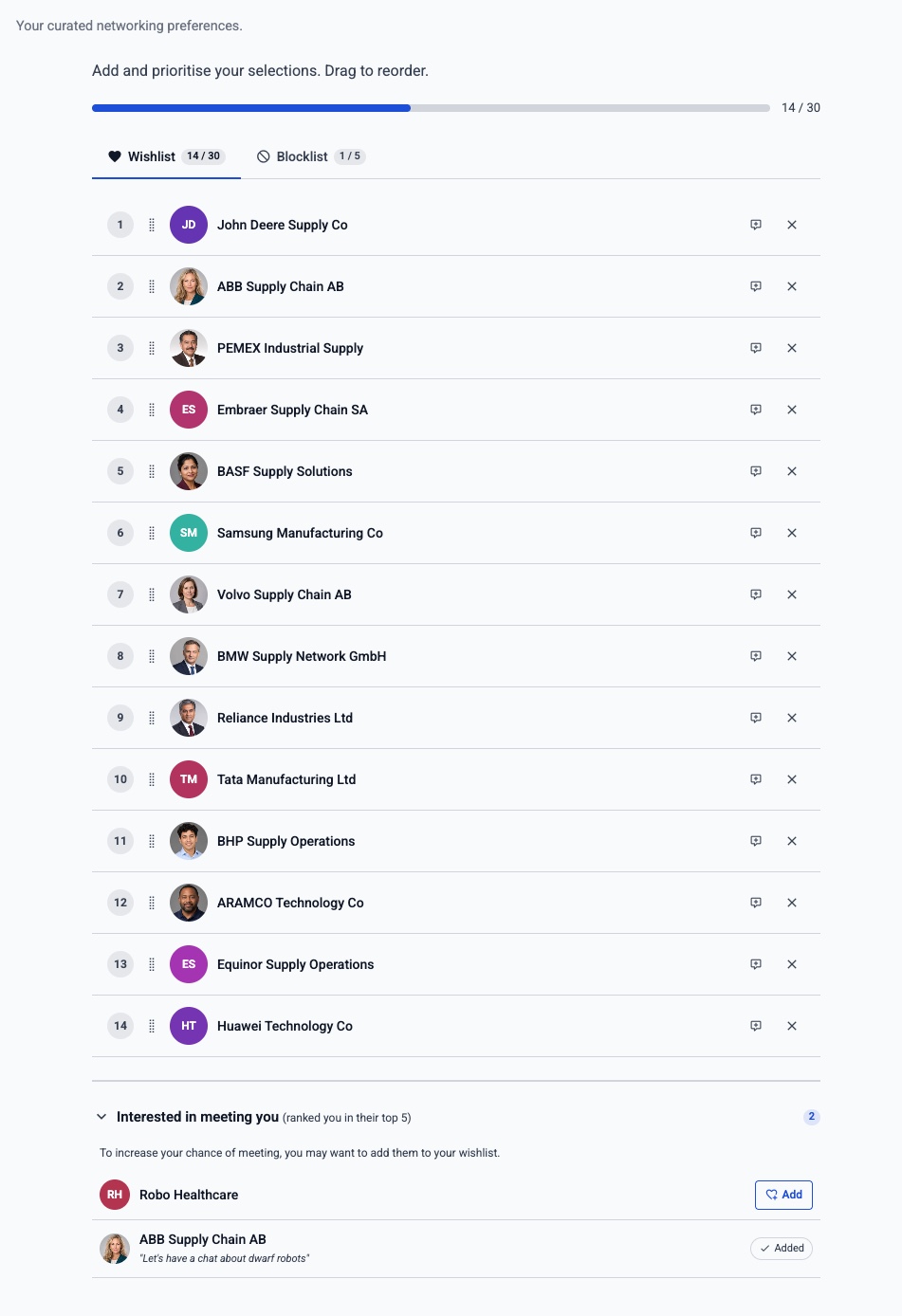
Participants submit ordered preferences using the profile information and questions selected by the organiser.
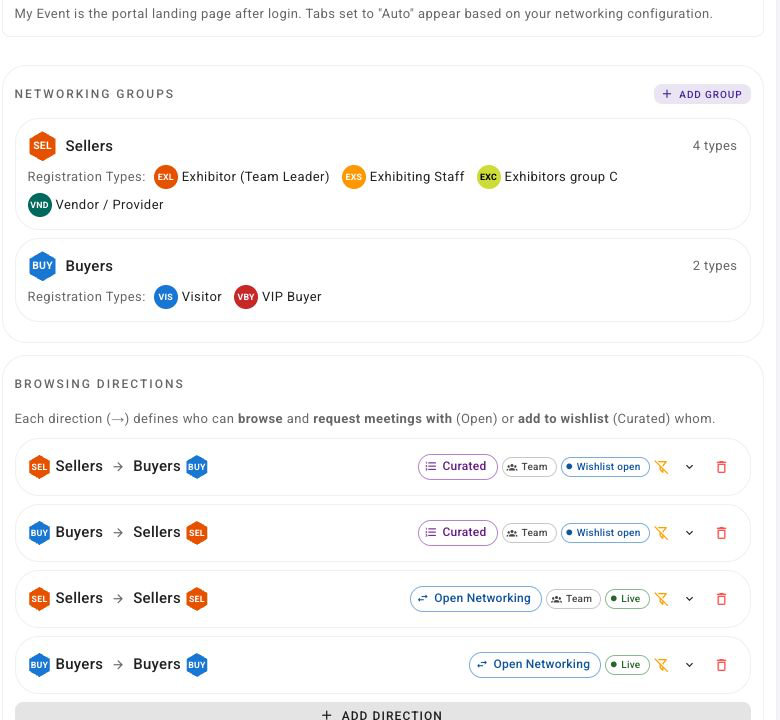
The organiser can create, inspect, adjust, schedule, and operate proposed matches instead of accepting an opaque result.
Capabilities
A curated networking workflow you can inspect and operate
Networking Test Mode
Configure the programme before launch, then use trusted organiser imitation to rehearse wishlists, requests, responses, matching, review, and scheduling as selected participants without exposing networking to real registrants.
Ordered wishlists
Let participants rank the people or organisations they most want to meet. Set limits, deadlines, and whether a reason or custom questionnaire is required for each choice.
Mutual and one-sided matching
Prioritise reciprocal demand where appropriate, recognise high-value one-sided requests, and use controlled fill-gap matching to improve schedule coverage.
Complementary profile scoring
Compare one side’s needs with the other side’s capabilities using structured cross-field rules and explicit option links. Mandatory criteria can exclude an incompatible pair instead of letting shared keywords inflate its score.
Optional AI Intent Match
Add objective-led AI Intent Match as one curation strategy alongside Mutual Wishlist, One-Sided Wishlist, Profile Match and Top Up. Organisers can inspect fit bands and grounded explanations without losing the existing rules or manual controls.
Blocks and safeguards
Prevent unsuitable pairings with participant or organiser blocks, respect directional meeting limits, and keep incompatible registration types or relationships apart.
Preliminary review
Release a proposed view before final scheduling when the programme allows it. Participants can request limited removals, while organisers approve or reject and consider replacements.
Full manual control
Inspect every proposed meeting, add or remove matches, adjust priority, lock important decisions, and intervene wherever event knowledge should override the automated recommendation.
Team and booth assignment
Combine team-member choices into one composite wishlist while preserving who selected each preference. Use that attribution to guide assignment and let leaders move meetings between members.
Concurrency and availability
Schedule multiple representatives from one organisation without double-booking a person or exceeding the concurrent capacity available at the stand, booth, or meeting place.
Conflict-aware scheduling
Respect attendance days, sessions, blocked time, personal and team meetings, meeting limits, duration, slot rules, and place capacity when producing the schedule.
What-If resolution
When a meeting cannot fit, see why and evaluate proposed single- or multi-meeting moves before applying changes. The organiser can understand the trade-off rather than guessing.
Flexible meeting places
Use dedicated stands and tables, automatically allocated shared pools, public meeting points, or secure virtual rooms with capacity and availability rules.
Fairness and fulfilment analytics
Measure active-wishlist fulfilment, meeting distribution by registration type, most-requested participants, slot and place use, declines, cancellations, feedback, no-shows, and meeting occurrence.
When to use it
Use curated networking when meeting quality is part of the event promise
Buyer–supplier appointment programmes
Run business matchmaking and curate relevant one-to-one meetings while controlling qualifications, demand, fairness, teams, and schedule density.
Sponsor and delegate meetings
Deliver a defined number of appropriate appointments as part of a sponsorship package without forcing every attendee into hosted-buyer terminology.
Investor, innovation, and accelerator events
Match organisations using structured criteria and stated interest, then build reliable appointment schedules around pitches and programme sessions.
Government, trade, and delegation events
Coordinate bilateral meetings across countries, sectors, organisations, or delegations with privacy and protocol-aware organiser control.
One connected platform
Curated networking uses the context around every participant
Yes. Networking Test Mode lets trusted organisers imitate selected participants and exercise the relevant Portal and organiser workflows before committing to Live networking. Real registrants cannot access networking, Test communications are suppressed by default, and controlled redirection is limited to verified organiser test recipients. Upgrade to Engage when ready to Go Live; disposable Test interactions are removed while configuration is retained.
Does EventGen include AI event matchmaking?
Yes, as an optional layer. AI Intent Matchmaking can add natural-language participant discovery, objective-led recommendations, grounded Meeting Fit and organiser AI Intent Match. Events can also run complete wishlist, Profile Match, review and scheduling workflows without enabling AI.
What is curated networking?
Curated networking is an organiser-led process for identifying relevant participant pairs and turning them into scheduled meetings. It is also described as curated matchmaking, business matchmaking, B2B matchmaking, or event meeting scheduling. EventGen combines wishlists, structured profile data, matching rules, manual review, team assignment, conflict-aware scheduling, places, communications, feedback, and analytics.
Can EventGen run one-to-one business matchmaking meetings?
Yes. Organisers can match buyers with suppliers, sponsors with delegates, investors with founders, or other participant groups, then review and schedule those one-to-one meetings around availability, sessions, teams, meeting places, and programme rules.
Are one-to-one meetings the same as 1-to-1 or 1-2-1 appointments?
Yes. One-to-one meetings, 1-to-1 meetings, 1-2-1 appointments, and pre-scheduled appointments are common names for the same basic format: two relevant participants are given a confirmed time and place to meet. EventGen supports the terminology your audience already uses.
How does curated networking support a hosted buyer programme?
A hosted buyer programme is one event format that uses curated networking. EventGen can qualify buyers and suppliers, collect meeting wishlists, build and review proposed matches, and schedule the final one-to-one appointments. The same curated networking workflow can also support sponsor–delegate, investor–founder, delegation, partner, procurement, and supplier meetings.
Does an algorithm decide every meeting?
No. EventGen can generate proposed matches from preferences, profile criteria, and programme rules, but organisers can inspect, add, remove, prioritise, lock, replace, and manually schedule meetings at every phase.
Can organisers use participant networking objectives when curating meetings?
Yes. When AI Intent Matchmaking is enabled and ready for that direction, organisers can review AI Intent Fit in Manual Networking or use AI Intent Match as one optional automatic curation stage. Wishlists, Profile Match, eligibility, blocks, availability, capacity and organiser judgement remain separate and authoritative.
Why do some matchmaking systems recommend direct competitors?
Similarity-based systems can interpret two near-identical seller profiles as highly compatible because their sectors, products, interests, and language overlap. For B2B meetings, similarity is not enough: the system must understand each party’s role and whether one side’s need complements the other side’s capability.
How does EventGen prevent competitor matching?
Organisers define directional relationships between participant groups, so sellers do not need to browse or meet other sellers at all. Within an eligible buyer–supplier relationship, cross-field rules compare needs with offerings, mandatory criteria can exclude incompatible pairs, and ranked wishlists, blocks, preliminary review, and organiser controls add further safeguards.
How are scheduling conflicts handled?
Scheduling checks attendance days, programme sessions, blocked availability, existing meetings, team capacity, concurrency, meeting limits, and place capacity. When something cannot fit, What-If explains the conflict and proposes possible moves before the organiser applies them.
Can exhibitors or teams share a wishlist?
Yes. Team members can contribute to a composite wishlist while EventGen records who made each choice. That attribution guides assignment, and team leaders can prioritise the shared list and move meetings between available members.
Can participants review proposed matches?
If the organiser enables preliminary review, participants can see proposed partners before the final schedule and request a limited number of removals. The organiser approves or rejects requests and can evaluate replacements.
Can we also offer open networking?
Yes. EventGen can run organiser-led curated networking, attendee-led open networking, or both at the same event. They share profiles, privacy rules, availability, places, communications, and itineraries.
Use your event website or describe what you have in mind. Review an editable first version before signing up, then finish the details in your dashboard.