Why Similarity Matching Fails at B2B Events
Why direct competitors can look like ideal matches to a similarity-first algorithm, and how business-context matchmaking creates more useful buyer–supplier meetings.
By EventGen product team
Two suppliers sell similar products to the same market. Their profiles contain the same sectors, services, regions, interests, and commercial language. A similarity-first matchmaking system sees a remarkably strong match.
The people involved see an awkward meeting with a direct competitor.
This is one of the clearest examples of why similarity is not compatibility in B2B event networking. Shared characteristics can be useful evidence, but only after the system understands what each participant is there to do.
Evidence note: This is a first-hand explanation of EventGen's current matchmaking method, based on the product's implemented relationship, profile-rule, wishlist, review, scheduling, and place-allocation workflow. The supplier example is illustrative. This is not a customer outcome study and does not claim that one method guarantees a commercially successful meeting.
Why direct competitors can receive a high match score
Basic profile matching asks a simple question: how much do these two records have in common?
That approach can work for peer networking. Two professionals in the same discipline may genuinely want to compare experiences. It is much less reliable in a buyer–supplier programme, procurement event, investor showcase, or other setting where the desired relationship is complementary.
Consider two software vendors whose profiles both say they:
- serve enterprise retailers;
- provide AI-powered supply-chain technology;
- operate in the UK and Europe;
- want to meet retail decision-makers; and
- focus on inventory optimisation.
Their profiles overlap almost perfectly because they compete. The data is not wrong; the question being asked of it is wrong.
B2B matchmaking needs several different decisions
A useful business meeting is not produced by one universal score. The workflow needs to answer several separate questions:
- Eligibility: Should these participant roles be able to discover or meet each other at all?
- Compatibility: Does one side need something the other side can provide?
- Intent: Have either or both participants expressed an interest in the meeting?
- Programme judgement: Does the organiser know something that should add, remove, or prioritise the introduction?
- Feasibility: Can the meeting fit within both schedules, the event programme, team capacity, and available places?
Collapsing all five into “these profiles look alike” creates impressive-looking scores and disappointing diaries.
1. Define the business relationship first
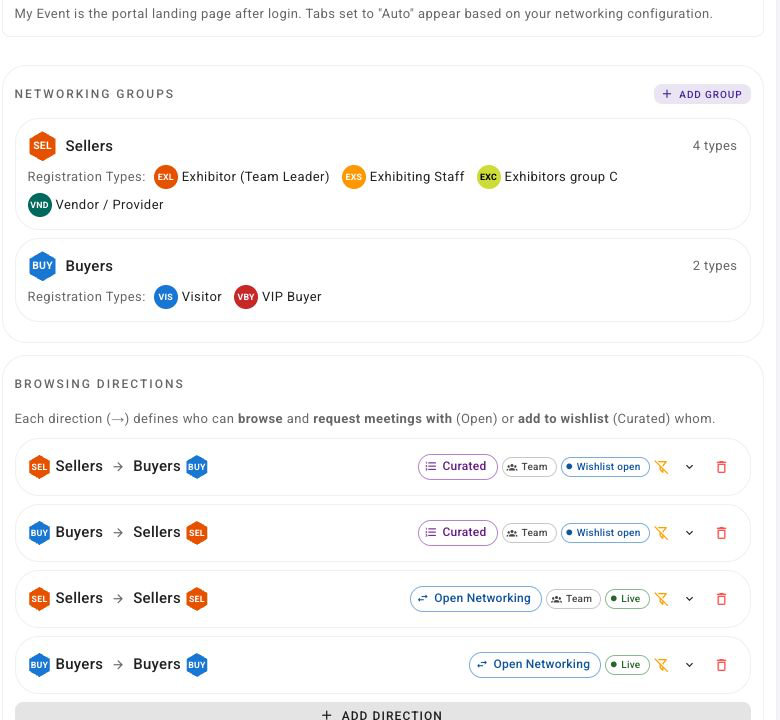
EventGen networking software starts with directional groups and relationships. An organiser can define Buyers → Suppliers, Suppliers → Buyers, Investors → Startups, Sponsors → Delegates, or the structures appropriate to the event.
That decision controls who can discover and interact with whom. If suppliers should not browse or request meetings with other suppliers, the organiser does not create that seller-to-seller relationship. Direct competitors are therefore outside the eligible meeting pool rather than merely receiving a slightly lower score.
Peer networking can still exist as a separate relationship when the event genuinely wants it. The important point is that it is deliberate, not an accidental consequence of similar profiles.
2. Match needs with capabilities
After eligibility comes compatibility. Matching the same field on both sides is sometimes appropriate, but B2B programmes often need cross-field matching.
For example:
- a buyer answers “Products sought”;
- a supplier answers “Products offered”;
- a buyer identifies target projects or purchasing priorities;
- a supplier identifies relevant capabilities, markets, or expertise.
EventGen lets the organiser link compatible options between those fields. The system can therefore compare demand on one side with supply on the other, rather than rewarding two sellers for describing the same offering.
Weighted criteria express relative importance. Mandatory criteria go further: when a required condition is not satisfied, the pair can be excluded instead of remaining eligible with a weaker score.
The score is also explainable. Organisers can inspect the field-level contribution and test two profiles before relying on a rule set.
3. Add participant intent
Profile compatibility is evidence, not consent. Curated matchmaking can also use ranked meeting wishlists.
A mutual wishlist match shows that both participants selected each other. One-sided interest can be considered under separate limits and priorities. Organisers can decide how much weight to give each side. For example, buyer demand may be more important in a hosted buyer programme.
Participants can also block people they do not want to meet. A blocked pair is excluded from automatic matching, providing a direct safeguard for conflicts or commercial sensitivities that structured profile data may not capture.
4. Keep the organiser in control
No event database contains every relevant piece of commercial context. The organiser may know about an existing relationship, a sensitive account, a sponsorship commitment, an urgent buying project, or a recent change that has not reached the profile.
EventGen therefore treats automated matches as a reviewable proposal. Organisers can inspect, add, remove, replace, prioritise, or manually confirm meetings.
An optional preliminary review can show proposed meetings to participants before final scheduling. Participants may request a limited number of removals, while the organiser reviews the reason and considers a replacement. An approved removal creates a block so the same pair is not immediately recreated by the next automatic run.
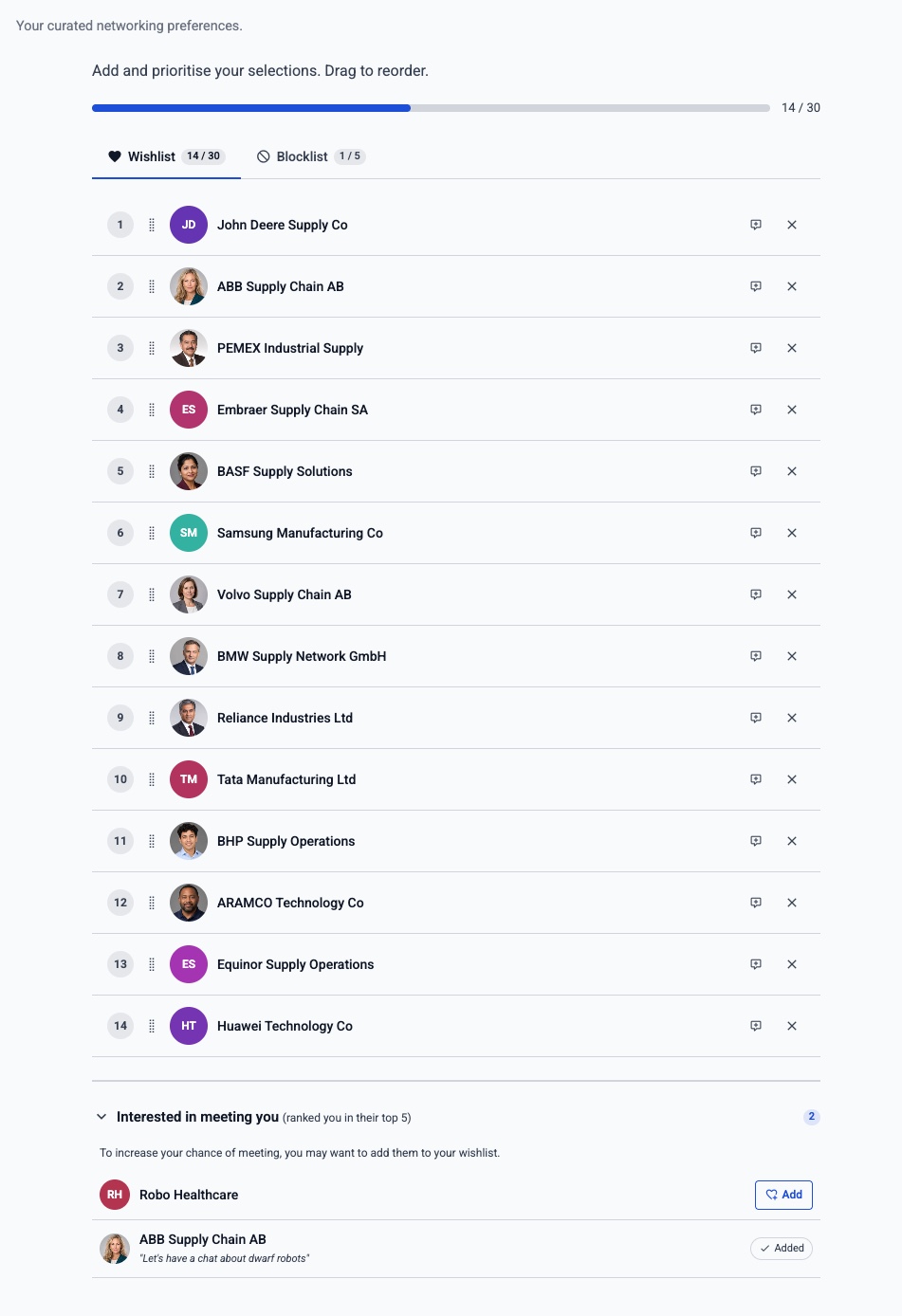
A real attendee-facing capture of the ranked wishlist used as one source of participant intent.
5. Schedule only meetings that can actually happen
Even an excellent commercial match is useless if the participants cannot attend it.
EventGen schedules around attendance days, programme sessions, personal availability, existing meetings, team-member assignment, concurrent booth capacity, meeting limits, time slots, and meeting-place capacity. When a meeting cannot fit, What-If tools explain the conflict and can propose changes for the organiser to review.
This is why a serious matchmaking workflow extends beyond recommendations. It must turn complementary demand into a meeting that is eligible, wanted, reviewed, and operationally possible.
A real organiser-facing capture of proposed meetings in the EventGen matchmaking workflow.
What this product evidence establishes
The implemented workflow shows that EventGen keeps distinct controls for:
- directional eligibility between participant groups;
- need-to-offering compatibility and mandatory criteria;
- participant preference and blocking;
- organiser review and manual intervention; and
- schedule, team, availability, and place feasibility.
Those controls address different failure modes that a single similarity score cannot represent. They do not guarantee that two people will accept a meeting or produce a business outcome; meeting quality still depends on participant data, programme design, organiser judgement, and what happens in the conversation.
What organisers should ask a matchmaking supplier
When evaluating B2B networking software, ask:
- Can we define exactly which participant groups may meet each other?
- Can we compare “looking for” fields with different “offering” fields?
- Can a required criterion exclude a pair completely?
- Can we see why a match received its score?
- Can participants rank choices and block unsuitable partners?
- Can we prioritise mutual interest or one side’s preferences?
- Can organisers inspect and change every proposed meeting?
- Can participants review proposals before the final diary is released?
- Does scheduling respect sessions, availability, teams, limits, and places?
The answers reveal whether the product is producing business meetings or merely ranking similar-looking profiles.
Match buyers to solutions, not sellers to their lookalikes
The purpose of B2B matchmaking is not to prove that two profiles share vocabulary. It is to create a useful commercial relationship between complementary participants.
EventGen Hosted Buyer Software combines role-aware relationships, structured cross-field compatibility, mandatory eligibility rules, ranked wishlists, participant blocks, organiser review, and conflict-aware scheduling in one workflow.
You can start free and explore the networking model before enabling a full hosted buyer or curated matchmaking programme.