Define who should meet
Directional relationships separate buyers, suppliers, investors, startups, sponsors, and other roles. If sellers should not meet sellers, they are not placed in that meeting relationship.
Networking software for events
Give attendees a searchable networking directory and the tools to find relevant people, request or book one-to-one meetings, reschedule, and manage appointments themselves. EventGen keeps attendee matchmaking, profiles, privacy, availability, places, communications, and personal itineraries connected to the rest of your event.
Start with a free account. No credit card required.
The problem
Many event apps stop at a directory or a messaging inbox. Attendees can see that the right people are present, but they still have to negotiate times elsewhere, remember where to meet, and manually protect gaps around sessions. The organiser has little visibility into whether useful connections are actually happening.
EventGen treats networking as a complete meeting workflow, with relevance judged as a business question rather than a keyword contest. Organisers decide which attendee groups can discover and approach each other, what makes two sides compatible, what information becomes visible at each stage, and whether a relationship uses requests or instant booking. Attendees handle the conversation from discovery to confirmed itinerary without leaving the event portal.
Similarity is not compatibility
Two companies can use almost identical words because they sell the same thing to the same market. A similarity-first engine may call that a strong match. EventGen understands the business relationship first, then uses structured compatibility and participant intent inside those boundaries.
Directional relationships separate buyers, suppliers, investors, startups, sponsors, and other roles. If sellers should not meet sellers, they are not placed in that meeting relationship.
Cross-field rules match what one side is looking for with what the other side offers. Mandatory criteria can remove an incompatible pair instead of merely giving it a lower score.
Ranked and mutual wishlists, participant blocks, preliminary review, and organiser controls turn the score into a reviewable recommendation, not an unexplained final decision.
The result is complementary matchmaking: buyers meet relevant providers, investors meet suitable opportunities, and participants keep a meaningful veto instead of receiving a diary filled by keyword coincidence.
See how it works →How it works
Create directional networking relationships between ticket or registration types, with separate discovery, privacy, booking, and communication rules.
Choose the fields people can search and see in lists, full profiles, requests, confirmed meetings, and itineraries.
Attendees browse, search, request or direct-book, accept or decline, suggest another time, and manage their availability.
EventGen checks conflicts, allocates places, sends lifecycle notifications, updates itineraries, and reports how the networking programme performed.
See it in action
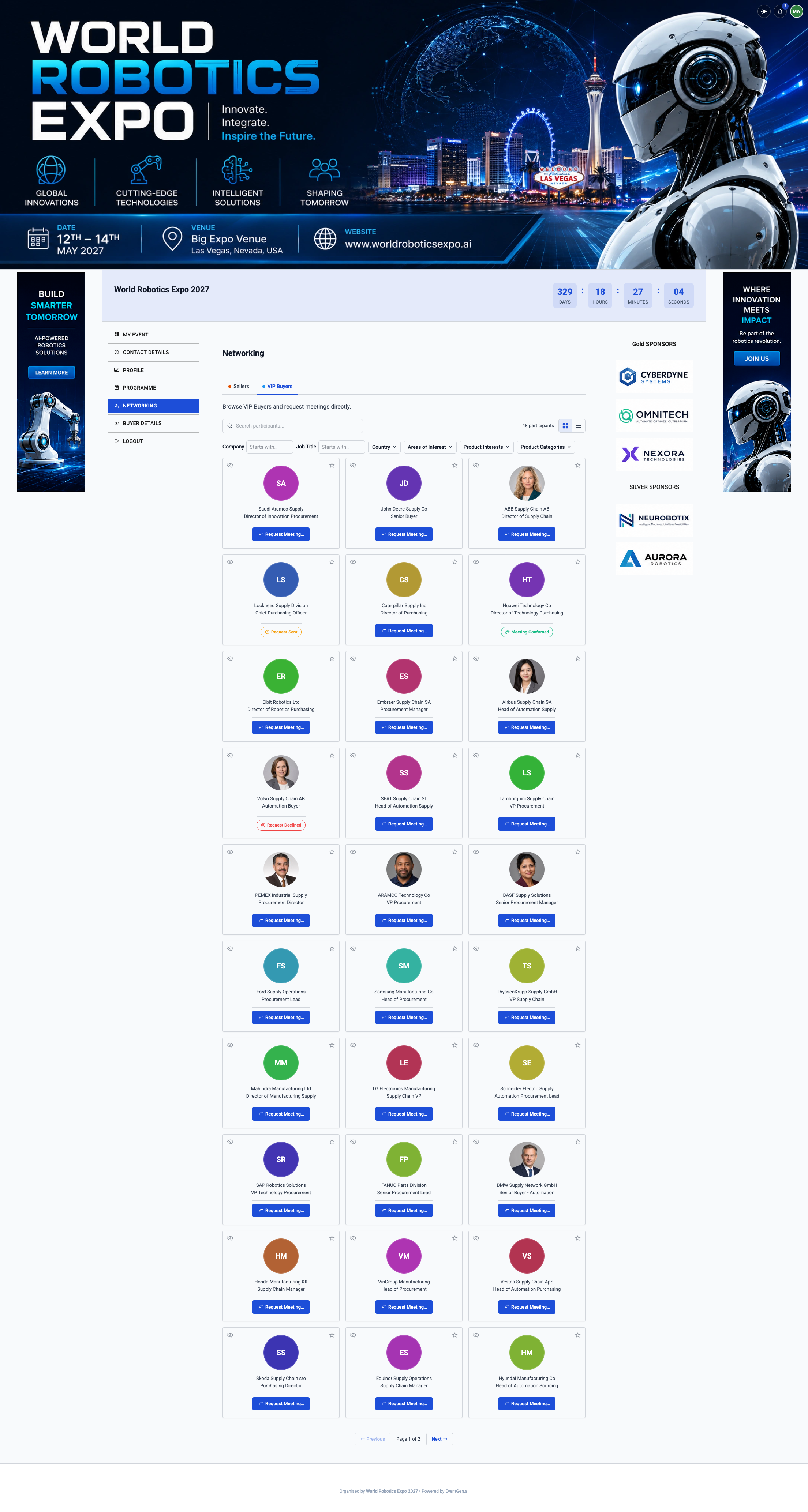
Attendees browse the people they are allowed to discover, with organiser-controlled profile fields and clear meeting actions.
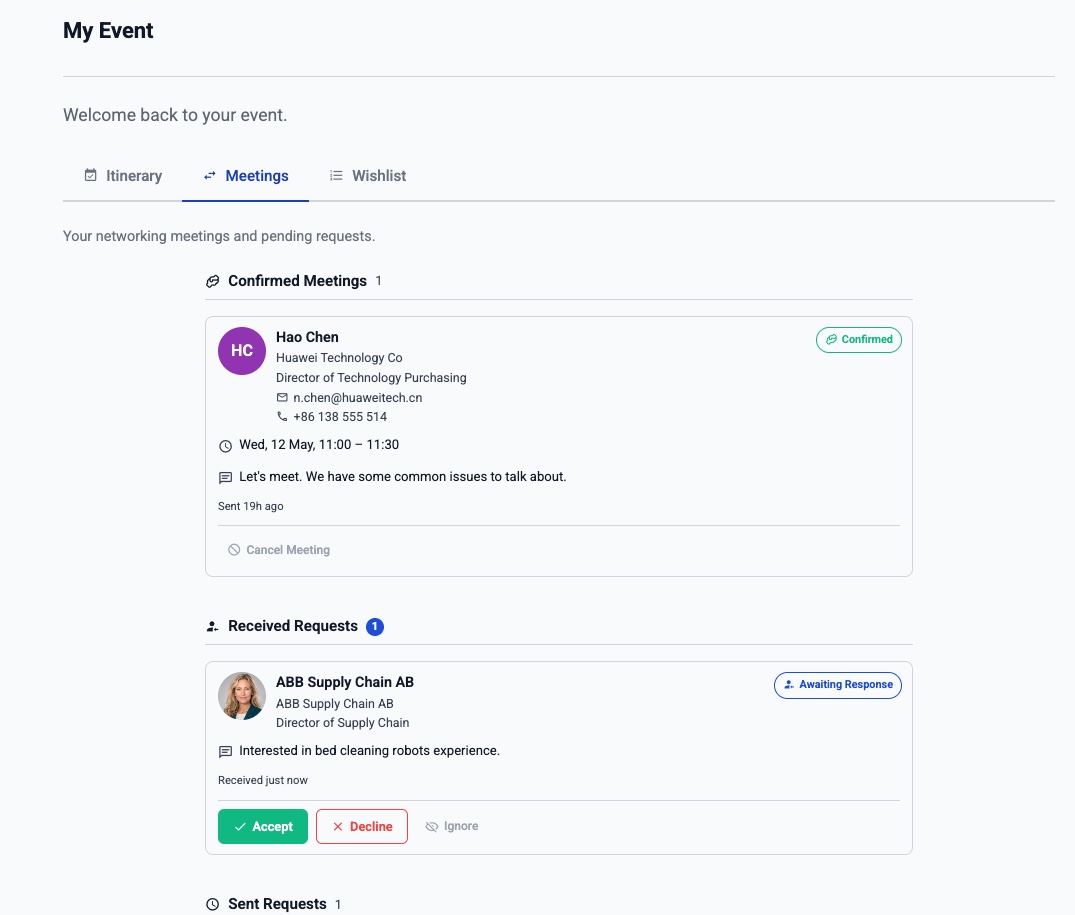
Confirmed meetings, received requests, and sent requests stay together in the attendee portal and personal itinerary.
Capabilities
Configure the journey before launch, then use trusted organiser imitation to experience the Portal as selected participants. Rehearse requests, responses, booking, availability, and other relevant workflows without making networking visible to real registrants.
Buyers may be allowed to approach suppliers while suppliers can only respond, or both directions can be open. Configure each relationship independently instead of applying one global rule.
Let people browse or search the fields relevant to the event, from role and organisation to interests, product categories, regions, or custom registration answers.
When enabled for a direction, participants can describe who they want to meet in natural language across visible freehand profile information and organiser-selected, security-scanned files or images. Exact filters and networking rules remain authoritative.
Reveal different fields in search results, profile views, meeting requests, confirmed meetings, and itineraries. Contact information does not need to be exposed before a meeting is agreed.
Use approval-style meeting requests where the recipient accepts, declines, ignores, or suggests another time, or allow immediate booking where the event format supports it.
Attendees block times they cannot meet. EventGen also respects their event attendance, existing meetings, programme sessions, and the networking slots made available by the organiser.
Meet at dedicated stands or tables, shared table pools, public locations, or secure virtual rooms. Capacity and simultaneous use are checked before confirmation.
Ask why someone wants to meet or use a custom request form for topics, products, priorities, budgets, or other context that helps the recipient make a useful decision.
Allow attendees to suggest another time or reschedule within your rules. EventGen rechecks participant, team, session, and place conflicts before making the change.
Where appropriate, selected attendee types can invite eligible colleagues or specialists to a confirmed meeting, subject to guest limits and schedule checks.
Keep people informed when a request arrives, a meeting is confirmed, declined, cancelled, rescheduled, or changed. The portal itinerary updates from the same source.
Venue check-ins can highlight whether meeting participants are present. Organisers can identify meetings at risk and contact, cancel, reschedule, or replace where necessary.
Measure requests, confirmations, declines, response speed, cancellations, meeting distribution, place and slot use, feedback, attendance, no-shows, and which participants attract the most demand.
When to use it
Conference networking helps members and delegates discover peers, experts, sponsors, or partners and arrange meetings around the programme.
Trade show networking lets visitors book time with exhibitors, while exhibitors manage availability around stand staffing and existing appointments.
Participants find relevant organisations using structured profile data and request conversations with clear business context.
Use physical, public, or virtual meeting places while keeping every appointment in one personal schedule.
One connected platform
Use trusted organiser imitation to rehearse this participant journey before real registrants can access it.
Registration answers become searchable, visibility-controlled networking data without a second profile database.
Meeting availability can respect sessions, attendance days, and personal programme choices.
Add organiser-led matchmaking, review, and algorithmic scheduling when self-service networking is not enough.
Optionally add natural-language discovery, objective-led playbooks and organiser intent curation without replacing the ordinary directory or meeting workflow.
Give exhibitors and hosted buyers an offline-capable mobile companion for leads and meeting-day activity.
Event networking software helps attendees discover relevant people and turn that interest into conversations or scheduled meetings. EventGen combines searchable profiles, privacy rules, meeting requests or direct booking, availability, place allocation, notifications, itineraries, and reporting.
Yes. In open networking, attendees browse or search eligible profiles, send a request or direct-book where enabled, respond, suggest another time, reschedule, cancel, and manage their own availability from the portal.
Yes, when the organiser enables AI Intent Matchmaking for that direction. Participants can describe who they want to meet across profile information visible for the direction and organiser-selected, security-scanned files or images. It is optional and the ordinary directory, exact filters and meeting workflow remain available.
Yes. One-to-one networking meetings are also commonly called 1-to-1 meetings or 1-2-1 appointments. Attendees can request or book them from the event portal, while EventGen checks availability, programme sessions, existing meetings, and meeting-place capacity.
Yes. Networking relationships are directional and can be configured between registration groups or ticket types. Organisers also control which profile fields appear during search, browsing, requests, confirmed meetings, and itineraries.
EventGen does not rely on profile similarity alone. Organisers define which groups may discover or meet each other, so competitors can be kept outside the relevant relationship. For buyer–supplier matching, cross-field rules compare what buyers need with what suppliers offer; mandatory criteria can exclude incompatible pairs. Wishlists, participant blocks, preliminary review, and organiser controls provide further safeguards.
EventGen checks the attendee’s event days, blocked availability, existing meetings, relevant programme sessions, team concurrency, and meeting-place capacity before scheduling or rescheduling.
Yes. Open networking lets attendees choose and arrange their own meetings. Curated networking gives the organiser a structured matchmaking workflow using wishlists, matching, review, scheduling, and controlled release. EventGen can run either mode or both at the same event.
EventGen is an event networking platform whose attendee experience runs in the branded event portal, so profiles, meetings, programme, and itinerary stay together. The separate Lead Retrieval installable app provides an event-day meetings companion for exhibitors and hosted buyers.
Yes. In Networking Test Mode, trusted organisers can imitate selected participants in the Portal and exercise meeting requests, responses, booking, availability, and other relevant workflows. Real registrants cannot see or use networking. Test communications are suppressed by default, with controlled redirection only to verified organiser test recipients. Upgrade to Engage when ready to Go Live; Test interactions are removed and configuration is retained.
Yes. Free includes bounded Networking Test Mode with no credit card. Paid Base plans include the same organiser-only evaluation route. Live open and curated networking for real registrants requires Engage; Enterprise+ includes networking.
Explore related capabilities
Configure the journey, imitate selected participants, and go Live with Engage only when the experience is ready.
Learn moreRun organiser-curated meetings with wishlists, B2B matchmaking, review, and conflict-aware scheduling.
Learn moreManage the full hosted buyer programme, including teams, places, live operations, and analytics.
Learn moreAdd natural-language discovery and objective-led recommendations to the existing networking engine.
Learn moreLet exhibitors scan and qualify leads while hosted buyers use a mobile meeting companion.
Learn moreA practical guide to appointments, availability, places, conflicts, and event-day changes.
Learn moreSee why shared keywords can identify a competitor, and how business-context matching produces better B2B meetings.
Learn moreA practical guide to testing requests, responses, schedules, and communications before launch.
Learn moreUse your event website or describe what you have in mind. Review an editable first version before signing up, then finish the details in your dashboard.
Free includes up to one event place per calendar year, 50 registrants per event, core event tools, and Networking Test Mode. No credit card required.
When you sign up to keep your event, you agree to our Terms of Service and Privacy Policy.